
Fork Cutting Machine
Video shows the previous version of this machine.
Description
The MCFe-27 cuts and chamfers aluminium and steel fork steerers in one automatic cycle, with the cut held to ±0.2 mm and ±0.1 mm repeatability. Every steerer comes off the machine at the same length and square to its axis, so headset fit is decided by the machine, not by who is working that shift.
The fork is held still and self-centred while the tool does the work – less stress on the part, better accuracy and longer insert life. Moving between fork sizes from Ø1″ to 1.5″, or from aluminium to steel, needs no tooling change at all: the operator selects the order on the HMI, and up to 80 approved manufacturing orders are stored on the machine.
At under 0.6 m² on levelling castors it rolls into an existing line without lifting equipment, and below 74 dB it works beside your people instead of in a corner of its own. The cutting area is fully enclosed with an RFID-interlocked cover, and OPC UA is standard.
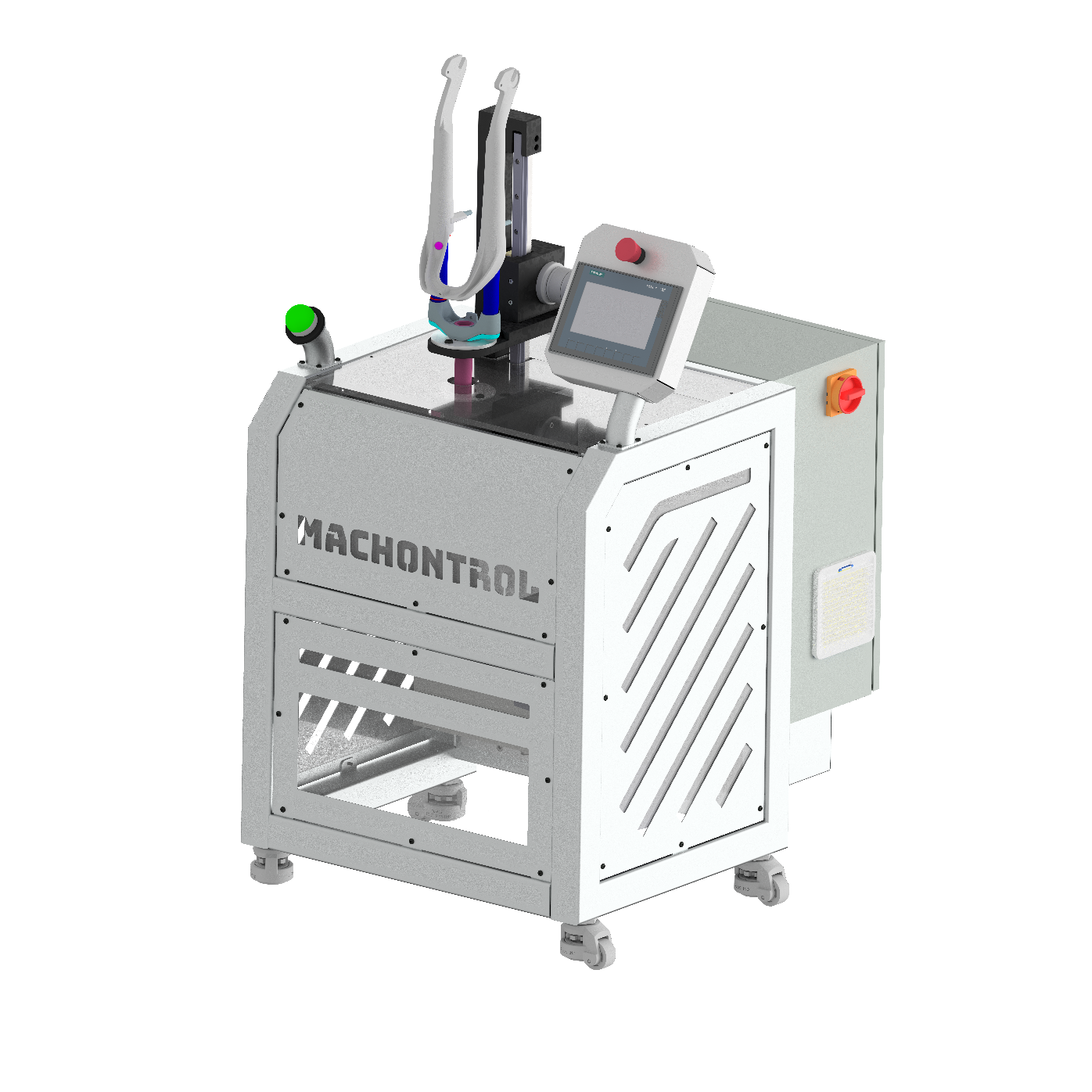

- Cut and chamfer in one cycle. 12–20 s per fork – the steerer comes out cut and chamfered, with no second station.
- Every steerer the same length. ±0.2 mm cut length and ±0.1 mm repeatability, so headsets seat the same on every bike.
- Change models without changing tools. Aluminium or steel, Ø1″ to 1.5″ – pick the recipe on the HMI and run.
- The approved settings, every time. Up to 80 manufacturing orders stored on the HMI, so what runs is what was signed off.
- Fits into the line you already have. 710 × 870 mm on castors, below 74 dB – it stands next to the assembly station, not in a separate room.
- Connected from day one. OPC UA as standard: send orders to the machine and read production data back from your office systems.
| Capacity | |
|---|---|
| Steerer tube capacity | Ø 1″ – 1.5″ (24.4 – 38.1 mm) |
| Cut length range | 125 – 330 mm (other ranges on request) |
| Materials | Aluminium and steel |
| Operation | |
| Cycle time | 12 – 20 s per fork (cut and chamfer in one operation) |
| Drive | Servo-controlled positioning |
| Tooling change | Not required between fork sizes or materials |
| Chip handling | Collection bin, conveyor optional |
| Dust extraction | Not required |
| Precision | |
| Cut length tolerance | ±0.2 mm |
| Repeatability | ±0.1 mm |
| Control & connectivity | |
| Control | Siemens PLC |
| HMI | 7″ Siemens HMI, up to 80 manufacturing orders |
| Connectivity | OPC UA |
| Installation | |
| Dimensions (w × l × h) | 710 × 870 × 1400 mm |
| Weight | 350 kg |
| Electrical connection | 400 V, 3-phase, 50/60 Hz |
| Sound level | Below 74 dB |
| Conformity | |
| CE conformity | EU Machinery Directive 2006/42/EC |
Frequently asked questions
Will it handle our fork range?
From 1″ to 1.5″ (24.4 to 38.1 mm) – straight and tapered, aluminium and steel, on the same machine. You do not need a second machine or a second setup for a different model.
How much time do we lose changing between fork sizes?
None. No tooling change between fork sizes or materials. Changeover is a recipe selection on the HMI, with up to 80 stored, so switching model is an operator action rather than a setup job.
What does a cut actually look like coming off it?
Cut and chamfer happen together in one operation, 12 to 20 seconds per fork, held to +/-0.2 mm cut length with +/-0.1 mm repeatability. The fork leaves finished – no deburring station behind it.
Do we need extraction for it?
No. Cutting aluminium and steel makes chips, not dust, so there is nothing to extract. Chips drop into a collection bin, and a conveyor is available if you want them cleared automatically.
Can you adapt it to our line?
Yes. We design, machine, weld and program everything in-house in Portugal, so changing a fixture, a stroke or the HMI logic for your process is engineering work rather than a special request to a factory on another continent.
Can it talk to our factory systems?
Yes. OPC UA is standard on every machine we build, not a paid option, and every machine conforms to EU Machinery Directive 2006/42/EC. If you are working toward a connected line, nothing here holds you back.
Reading and writing the machine’s order table from an office PC over OPC UA.